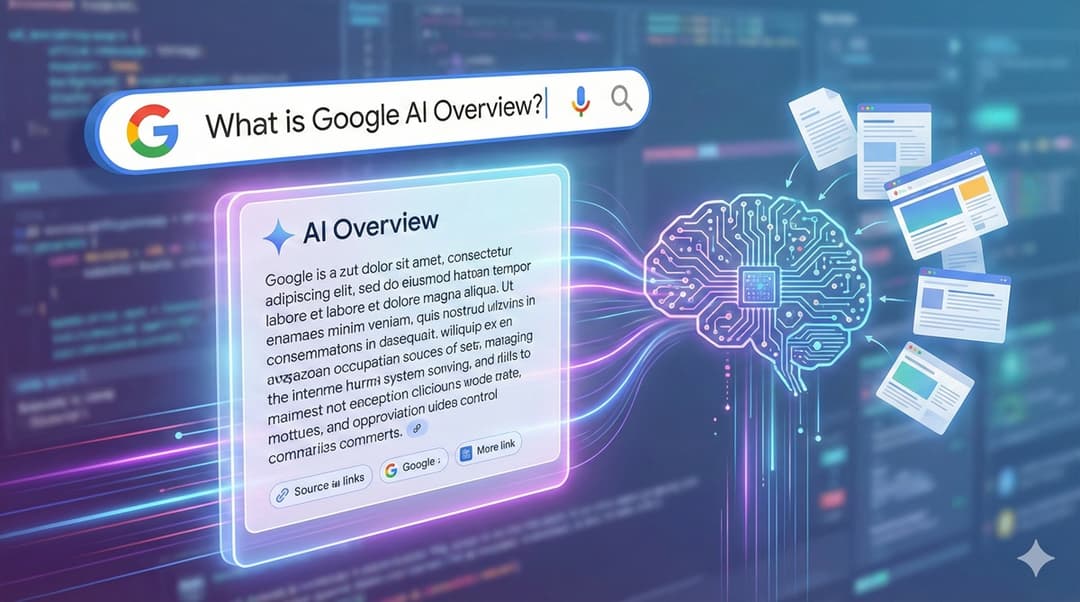

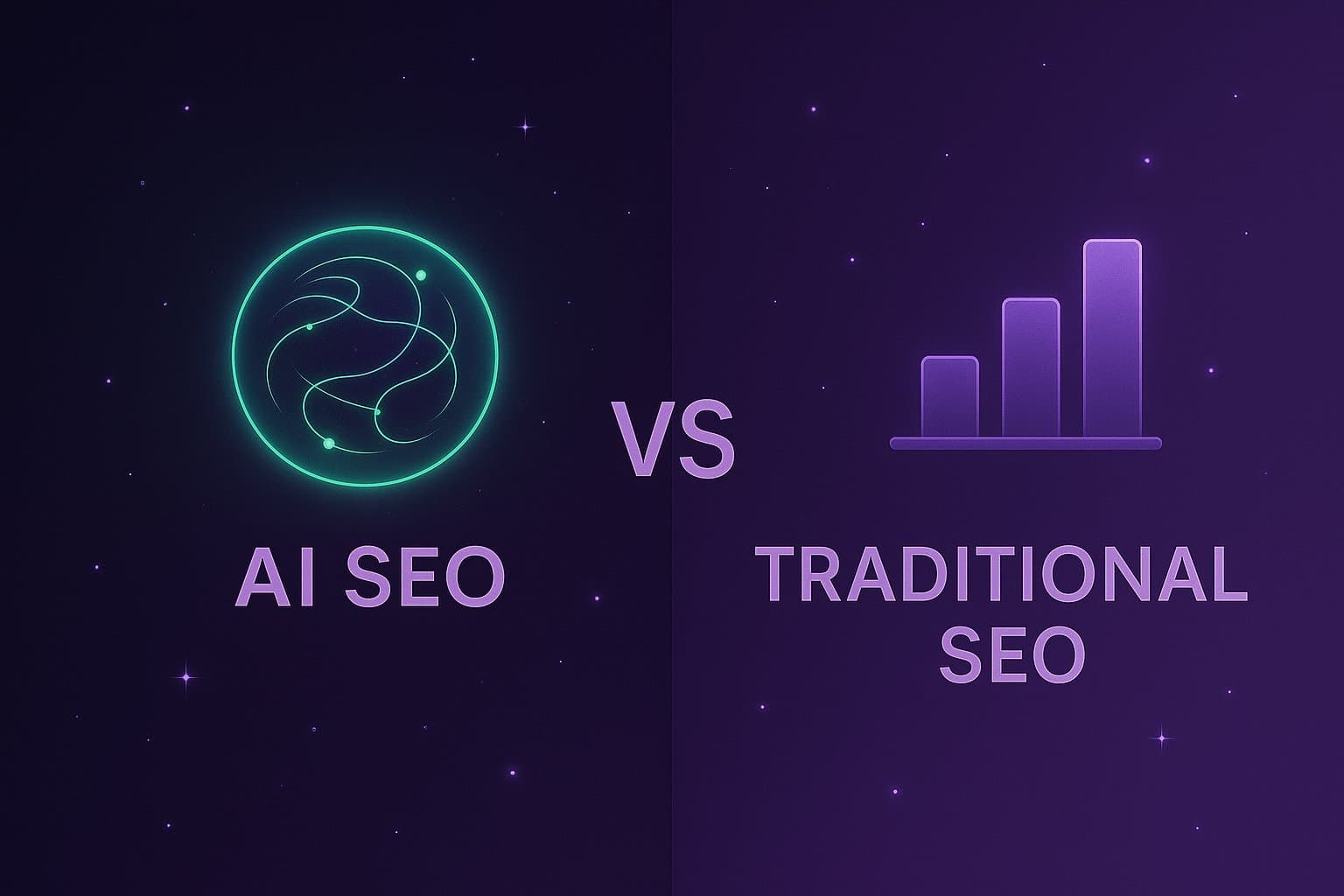
Search is changing fast. AI Overviews, conversational queries and multi-turn sessions are reshaping how people discover and evaluate solutions. Traditional SEO still drives compound value, but AI SEO adds speed, scale and new ways to win zero-click attention. If you’re new to the concept, see What is AI SEO and how does it work. This guide shows how user behavior, content optimization and data workflows differ, and how you can combine both to grow faster in 2025.
How search behavior is changing
Query style: short keywords vs conversational prompts
Traditional SEO centers on short or mid-tail keywords like “project management software.” In AI-led search, users type or speak prompts such as “I need a project management tool for a remote design team under $20 per user.” Prompts embed context – constraints, audience, budget, tasks – so answers must map to richer detail.
What that means for you:
- Target conversational long-tail phrasing that mirrors real questions and constraints.
- Answer with decision-ready specifics – pricing tiers, integrations, eligibility, timelines.
- Structure pages so a single passage can satisfy a narrow sub-question.
- Support voice and mobile UX with clear headings and concise definitions up top.
Search intent: navigational vs task-oriented
Classic intent buckets – informational, navigational, transactional – still matter. AI SEO adds task intent: the user wants to complete a step, not just learn. Prompts like “compare tape vs weave extensions for thin hair” blend informational and commercial research in one flow.
Practical implications:
- Map tasks across the journey – shortlist, compare, configure, calculate, verify.
- Create answer modules for each task: comparison tables, checklists, calculators, eligibility notes.
- Use entity-rich language so AI systems link your answers to recognized concepts, brands and specs.
Interaction depth: one-off queries vs multi-turn sessions
Traditional search is often one-and-done. AI search behaves like a conversation where the model remembers context and refines results with each follow-up. Users ask “best CRM for B2B SaaS,” then “only with native Slack integration,” then “minimum seats and price.”
To meet multi-turn expectations:
- Design content that supports progressive narrowing – clear facets, filters, and scannable sections.
- Offer layered answers: a quick summary, then deeper detail, then proofs and examples.
- Ensure internal links anticipate next steps – from overview to comparison to implementation.
- Add structured data so discrete facts are extractable at any turn.
For a broader strategic view, read How AI is changing the future of SEO.
Content optimization: from keywords to topics, passages and answers
Keyword targeting vs topic coverage
Traditional SEO picks primary keywords and builds pages around them. AI SEO prioritizes topic coverage – the breadth and depth needed to satisfy a whole cluster of related intents. That requires entity-first planning and tightly connected hubs.
How to execute topic coverage:
- Cluster semantically related queries into a hub with a pillar page and focused subpages.
- Use semantic SEO – include entities, synonyms and relationships that describe the topic space.
- Cross-link subtopics with descriptive anchor text that signals context to users and machines.
- Measure coverage gaps, not just rank gaps – where user tasks lack a dedicated answer block.
Page-level vs passage-level relevance
Google’s passage indexing and AI overview systems can surface a single paragraph, list or table from a long page. That rewards pages where each section stands on its own and directly answers a sub-intent.
Make passages perform:
- Lead with a definition or answer sentence before elaboration.
- Use precise subheadings that mirror user sub-questions.
- Include compact lists and mini-tables to convey steps, factors or specs.
- Cite sources or methodologies where claims could be contested.
Formatting for snippets vs formatting for AI synthesis
Snippet optimization focuses on a single SERP box. AI synthesis aggregates multiple sources to compose a fuller answer. You need formats that are easy to quote, merge and verify. As SGE evolves, learn How to optimize for Generative Engine Optimization.
- Provide answer-first paragraphs under each H2 or H3.
- Use consistent units, ranges and labeled columns so numbers are safely reusable.
- Add schema where applicable – FAQPage, HowTo, Product, Article, Organization – to expose structure.
- Create reusable components: pros-cons lists, comparison tables, step-by-step checklists.
- Prefer specific, measurable language over vague benefits – include thresholds, constraints and exceptions.
- Support E-E-A-T with author bios, dated updates and transparent methodologies.
Data handling and analysis: manual vs AI-driven
Traditional SEO relies on manual keyword research, ad hoc spreadsheets and periodic audits. AI SEO uses models to cluster, summarize and predict – while humans set strategy and review quality. For practical workflows, see AI for keyword research and search intent analysis.
- AI keyword clustering groups thousands of queries by intent and entity, revealing true topic demand.
- Content automation drafts outlines, metadata and first-pass copy that humans refine for tone and accuracy.
- Semantic analysis surfaces entities you should mention and link to, boosting machine understanding.
- Predictive insights flag decaying pages and cannibalization risks before traffic drops.
- Automated technical checks catch internal linking gaps, orphan pages and thin passages at scale.
At InSpace, we pair these capabilities with human editorial review so output quality stays high while workloads shrink. The result is faster iteration, wider coverage and lower marginal cost per page – without losing brand voice. If you want a partner to implement this, explore our AI SEO services.
AI SEO vs traditional SEO: quick comparison
| Aspect | Traditional SEO | AI SEO |
|---|---|---|
| Primary goal | Rank pages and grow clicks | Win answers in AI and SERP, reduce friction |
| Query model | Short to mid-tail keywords | Conversational, multi-constraint prompts |
| Optimization focus | Page-level keywords and links | Topic coverage, entities, passage quality |
| Content format | Long-form pages and blogs | Answer-first sections, lists, tables, FAQs |
| Data workflow | Manual research and spreadsheets | AI clustering, summarization, prediction |
| Technical priorities | Crawlability, speed, on-page hygiene | Structured data, extractable facts, internal link graphs |
| Measurement | Rankings, CTR, sessions | Coverage, answer share, assisted conversions |
| Scale | Linear with team size | Nonlinear – automation plus human review |
| Risks | Slow discovery, content gaps | Quality drift, hallucination without human oversight |
| Best use | Evergreen authority building | Rapid expansion and task-focused answers |
Your 2025 hybrid playbook
- Cluster demand with AI – group queries by task and entity to define hubs and subpages.
- Design pillars and passages – outline answer-first sections for each sub-intent.
- Automate the draft – generate outlines, titles and metadata, then human-edit for clarity and trust.
- Add structure – apply schema, build mini-tables and lists, and tighten headings to match sub-questions.
- Link the graph – connect related pages with descriptive anchors that reflect tasks and entities.
- Instrument coverage – track which tasks you answer and where users bounce or follow up.
- Predict and refresh – use decay alerts to update passages before rankings and answer share slip.
This human + AI fusion is how InSpace scales content while maintaining quality, enabling startups, scale-ups, agencies and enterprises to expand internationally without ballooning headcount.
FAQs
What is the difference between traditional SEO and AI SEO?
Traditional SEO optimizes pages to rank for keywords and drive clicks. AI SEO optimizes topics and passages so your answers are selected by AI systems and SERPs, using clustering, semantic SEO and structured data to match task-oriented, conversational queries.
Is AI better than SEO?
AI is not a replacement, it is an amplifier. Use AI for scale – clustering, drafts, insights – and use human expertise for strategy, brand voice and accuracy. The hybrid model consistently outperforms either approach alone.
Will SEO be replaced by AI?
No. Search engines still need fast, trustworthy, crawlable sites with strong information architecture. AI changes how queries are interpreted and answers are composed, but Technical SEO, content quality and links remain essential.
Is there a downside to using AI for SEO?
Yes – quality drift, factual errors and duplication can creep in if you publish unreviewed AI output. Mitigate with human editing, transparent sources, structured data and clear policies on originality and updates.